Friday, April 13, 2012

The Gift of Leadership

by Joseph Zolobczuk

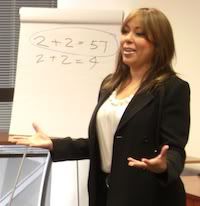
About once a year, YES Institute offers Leadership in Action to the community. This is a course that delves into the background principles of YES Institute as a community organization – the how of our work. We share a handful of core principles that have made a difference in our continued success so that others can learn and use them.

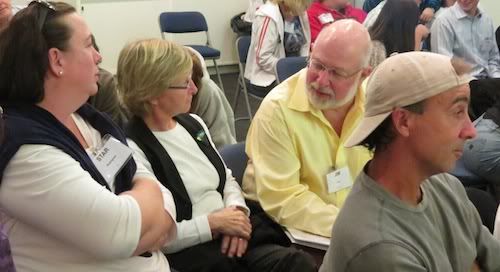
Rachel Sottile with course participants. 

This course is a gift we give to our community. When other human service and nonprofit organizations are better at what they we do, we all win. More bold leaders and stronger nonprofits means more people, families and communities are also strengthened and healed.

It's also a gift for us to be joined by some amazing leaders this afternoon. With us is Terri Cooper, Founder of 305 Yoga; Marisol Tamez, Director of Yoga Gangsters; Amy Garcia, Coordinator of Miami Mollies; Jowharah Sanders, Director of N.V.E.E.E.; and Erin Healy, Director of Youth L.E.A.D.  Each of these women are taking bold new actions with their organizations and are up to making a difference.

Here are a few of the key principles we've been discussing today:

When it's "about you," it's hard to be bold. When people say "yes" or "no", they are not saying no to you. But often, we make rejection and failure about us and take it to a personal level. With purpose as our focus, we are unstoppable.

Give your word, and keep it. What would our community look like if we all kept our word to everyone (or at least cleaned up the mess when we broke our word)? Can people count on you?

Communication is the problem. Communication is also the solution. MIT researchers on team effectiveness report, "How we communicate turns out to be the most important predictor of team success, and as important as all other factors combined, including intelligence, personality, skill, and content of discussions. The old adage that it's not what you say, but how you say it, turns out to be mathematically correct." What does communication look like in your community? Are there things not being spoken? Is there resentment or conflict? Who will go first and be the one to break the ice?

If you would like to request Leadership in Action for your organization or program, please contact YES Institute at 305-663-7195 or email@yesinstitute.org

Friday, April 6, 2012

“Bully” Movie: Thoughts and Reflections

by Caro Hernandez


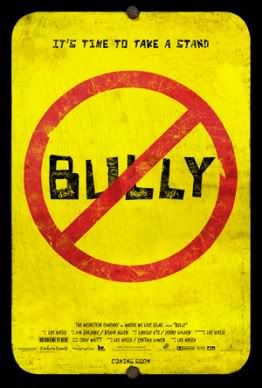
YES Institute staff and volunteers attended a screening of the new movie Bully before its nationwide release on April 13. The new documentary film, directed by Lee Hirsch, looks at the effects of bullying on children and their families. With over 13 million children in America reporting instances of bullying each year, it is safe to say this is a problem facing all schools. 

The film was shot from 2009 to 2010 and chronicles the lives of students who have been physically and emotionally bullied. This is coupled with the perspective of parents who have lost their children due to suicide brought on by bullying. Supporters of the movie are hoping to ignite much needed attention about the very real dangers of student harassment. 

One of the problems the film highlighted is that both teachers and parents don’t know what the solution is. Jowharah Sanders, the founder of NVEEE and host of last night's screening, held a Q&A session after the Miami premier. She said, “There is no ‘quick fix’ answer that will work for all schools. It will take the whole community to change hostile environments in schools today.” 
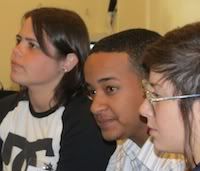
There were many public high school students in the audience. I was lucky enough to be sitting next them. Getting to hear their whispers and insights was eye-opening for me. Jowharah asked the audience, “What is the number one slur students are taunted with when they’re being bullied?” Instantly, every student around me yelled out, “that’s gay”, and “faggot”. 

While the question was not about gender and orientation, the answers made it clear–these topics impact everyone, especially youth. Expectations and fears surrounding gender and orientation are among the main roots of bullying. This is why we see education on these topics is so necessary. As we continue our work, providing community dialogues and courses for teachers, parents, and students, we also hope this movie inspires more people to join and learn together and become a part of finding solutions.

Tuesday, March 20, 2012

How Communication Can Reach the Heart


Sarah Carawan
by Sarah Carawan, North Carolina 

I traveled from Asheville to attend the Communicating Powerfully & ReVisioning Gender weekend at YES Institute recently, and am still reeling from the outpouring of love and commitment of the people I met.

After my marriage and the birth of my daughter, I was floored when I fell in love with a woman. There have been many ups and downs in the 35 years since I identified with the label “gay.” I now realize after being at YES Institute, that I have only just begin my own education on gender and orientation and see the power in examining my experience beyond labels.

In the Gender & Orientation Series™, I began to see the feminine / masculine binary concept is impressed upon us all throughout our lives. After nearly 60 years, I realized for the first time that my parents didn’t enforce narrow gender expectations on me. At home growing up, I recall I was always more boyish and interested in all things masculine. Thankfully, they let me explore who I was, and after participating in these courses I see this was a real gift.

Watching all the parents with their children, who were in varying stages of coming to terms with their child’s gender or orientation, was very moving. Some days, the course would begin and end with tears.

On the one hand, I didn’t understand the sadness because their intelligent, courageous and amazing children were living and breathing right next to them. Their loss was not a physical one, but rather a loss of expectations set into motion by a concept of body, gender, and orientation that was binary.

Many of these parents began to see that when it comes to gender and orientation for young people this is a conversation about life and death. Before these courses, I used to think un-accepting parents were narrow minded and bad parents. Now, I see nothing but good parents who received bad information. By the end of each day, I saw families become less afraid to allow each other to just be.

Sarah Carawan interacting with Star and Jim at YES Institute. 

There is no place like YES Institute. YES Institute is a beacon in the world for people who are struggling with gender or orientation, sometimes at the cost of their aliveness, or even their very lives. The level of welcoming, depth of knowledge, and outpouring of love I experienced at YES Institute will forever be a part of me. You cannot walk out of YES Institute without feeling bigger on the inside.

YES Institute's signature Communication Solutions™ course is taking place Saturday & Sunday, March 24 & 25 from Noon-6pm each day. Parents, teachers, students and medical doctors are participating in the course, as well as Spanish-language participants (full simultaneous bilingual translation will be provided). Call today to register at 305-663-7195 or email@yesinstitute.org 
Monday, March 12, 2012

In The Lives of Youth

Last week, CBS4 Miami News & Views aired an exceptional 2-part investigative story on homeless gay youth and the process of parental acceptance. While the impact on parents is often great, the consequences of bullying and rejection for young people can also be equally devastating. 

"Creating a Safer World", a mini-documentary produced by In The Life Media, captures the realities of youth impacted by gender and orientation. It also highlights the work of YES Institute and the innovative ways we are working to bring community-wide educational resources on these topics. 


Monday, February 20, 2012

Eva Leivas-Andino on CBS4 News & Views

For over 14 years, Eva Leivas-Andino, CFO of YES Institute, has been a champion for youth and families torn apart by fear and conflicting viewpoints over gender and orientation. She is—first and foremost—a mother and grandmother. Her passion for making communities safer and more inclusive is fueled by the love she has for her own family.

When her son, Paolo, came out as gay at age 20, Eva was extremely fearful of what people would say, of being rejected, and of facing accusations of being a bad mother. Her focus changed when Paolo opened up to her about the pain and isolation he experienced while growing up. From that moment forward, Eva devoted her life to education on gender and orientation, and is now a valuable resource for both English- and Spanish-speaking parents and youth.

Though Eva did not expel her child from their home, often many parents do. Available research reveals somewhere between 20–40% of America's homeless youth population comprise young people kicked out of their homes due to parental rejection of orientation or gender expression.

CBS4 Miami's Michelle Gillen and Eliott Rodriguez explore this topic and interview Eva in a two-part series that aired on Sunday, February 19th. If you are a parent that would like to speak with Eva, contact her at eva@yesinstitute.org

Part 1 of "Not In My House" explores the topic of gay homeless youth. Part 2 is an interview with Eva Levias-Andino with YES Institute.


Thursday, February 16, 2012

'Real' Men Wear Dresses


by Allison Yaffe, Intern 

Allison in NYC.
The concept of what constitutes 'real' masculinity is so prevalent today, it permeates every fiber of our social experience. We regard physical size, strength, independence, subordination of women, and liking the color blue, among other things, as proscribed necessities. That's not to say this ubiquity isn't true for femininity as well, especially since they exist in tandem with one another--substantiating meaning through their oppositions, according to the male/female gender binary in which they're situated. 

Before I attended Masculinity Distinguished, I felt that I already had a great understanding of masculinity--being the well-read women's studies major that I am. What this course provided me was the possibility of a world where each of us could express oursevles authentically to our hearts content. Unfortunately, the reality in which we find ourselves is all people, especially those wishing to express themselves as masculine, must constantly worry about how they will be perceived, sometimes with life or death consequences. 

After completing the course, I began to really notice the amount of times people assume I'm a lesbian because I have really short hair and sometimes wear "boyish" clothing, so I'm told. Why should men get to hold all the bow-tie rights? Why does having short hair mean that I'm either a boy or a lesbian? And what really really frustrates me is everyone's immediate need to have me label my sexual orientation. It's like, hello, we're meeting for the first time, so before we have a conversation and get to know one another, I am commanded to identify the direction of my attraction?! I just don't understand how that's even remotely relevant. 

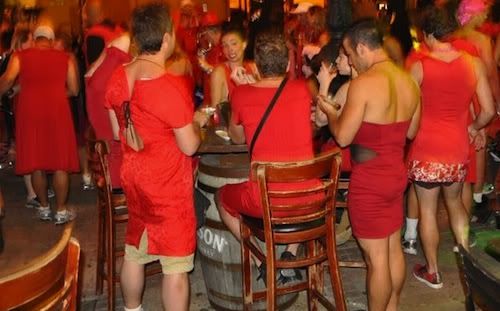
This past weekend I went on a hash run–which is pretty much like a pub crawl, but for runners. This specific one was the "red dress hash", where everyone runs in a red dress, women and men alike. About 130 of us, all decked out in our red skirts, ran through the streets of South Beach on Saturday night. People around us stopped dead in their tracks, yelling things like, "You disgusting cross dressers," "Look at all these tranny freaks," and spewing other obscenities that I won't reiterate. When we arrived at the pubs and got a chance to chat with people, they would ask if we were part of "some gay organization" before they inquired about why a hundred people were running in red dresses. Some of the people from the hash run spoke about how their friends wouldn't come out of fear for running into anyone they knew while in a dress. 

Red dress hash run, February 2012. 

The next day, I told my mother about my evening's adventures. She was dumfounded that "men, actual men, wore red dresses in public," immediately followed by, "Well, were they gay?" None of this was expressed in a negative or judgmental way, my mom was simply going along our cultural notions that she never sees men wearing dresses, and that men in dresses must be feminine and therefore gay. 

We are still a long way from seeing liberated men in dresses, however. This month in Atlanta, a group of males targeted a 20-year old shouting, "No faggots in Jack City," followed by brutal physical attacks. The YouTube video went viral, which set off a local community movement calling for hate crimes protection in Georgia. I really wish the attackers could come and experience the Masculinity Distinguished course, so they themselves can be more freed up around masculinity, no longer feeling the need to target other defenseless males in order to prove their illusory 'manliness'.
_________________________________________________________________

Masculinity Distinguished, YES Institute's newest course, will be held on Saturday, February 25, 2012 from 9am to 5pm at our education center in South Miami. To register, please contact Brittney McCabe at 305-663-7195 or email her at brittney@yesinstitute.org

Friday, February 10, 2012

New Partnership Increases Mental Health Resources across Miami-Dade


Open discussion on gender and orientation was a novel experience for more than 40 family therapy and substance abuse providers within the South Florida Behavioral Health Network (SFBHN). The first of three presentations for the SFBHN system of care took place in January, which coordinates counseling services across several Miami public agencies.

“How do I tell if my daughter is really bisexual, or if it’s only a phase?” was the opening question from a counselor.

Martha Fugate.
“Yes, that’s a great question. How can we know if it is a phase, and that’s what every parent wants to know,” said Martha Fugate, co-founder of YES Institute. “But before we answer that, I have a question for you. What difference would it make if it was a phase, or not?"

“Oh wow, I never thought about it like that,” responded the counselor. After this exchange, a flurry of hands went up, and the dialogue began.

The open and free flowing conversation gave the providers a chance to explore these topics and share their experiences. Not only did they feel better prepared to respond, but they learned of a great resource and partner in the community.

“This was an eye opening presentation, and gives me a way to better serve young people and their families.” - Community provider

One counselor related how her 8-year old nephew is repeatedly teased in elementary school with anti-gay slurs. When the school was unable to stop the bulling, the families only resort was to teach him to fight to defend himself. Physical violence soon led to bloody noses and cafeteria rumbles, but the insults and harassment continued. Both boys were suspended, with solutions far from sight.

“Violence is the last resort of the powerless. Schools, principals, teachers, and parents all want to stop bullying, and none of them know how. This leaves everyone feeling powerless and turning a finger to blame others for the failure. Real answers take time and a new ways of thinking and approaching the problem,” Fugate responded.

“I want and need to attend the courses so I can learn tools for communicating with parents about gay and transgender children.” - Community provider

Emily, a parent speaker. 
Emily, a YES Institute speaker and mother of a gay son, soon had tears rolling as she spoke about how lost she felt when her son came out to her. Her greatest love was this son who was now relaying something fearful and incomprehensible. Emily said, “How could I understand? I didn’t know where to turn to for help, even our therapist didn’t know what to do.”

The next speaker was Sky, who told the struggle of transitioning from a female birth assignment through his emerging male identity. As he spoke, those most unfamiliar with the topic of gender transitioning were riveted to his every word as he recounted his courageous journey.

“I learned that there is a difference between transgender and sexual orientation. I now see YES Institute as a resource that I can reach out to for further consultation and referral.” - Community provider

Sky (middle), a youth speaker. 
YES Institute is scheduled for two more sessions with the network, one in English and one in Spanish language. Stayed tuned for updates as our work progresses with the Miami-Dade system of care.

“Something I am going to do differently is to listen more closely and become more understanding.” - Community provider